Massachusetts solar incentives, 2026.
In 2026, most Massachusetts homeowners can offset the majority of their electric bill and pay off a solar system in roughly 6–8 years — driven by some of the highest electricity rates in the country (~31.5¢/kWh), full-retail net metering, and the state's SMART 3.0 production incentive, plus a $1,000 state credit and tax exemptions. Nexis files every form for you.
What you can stack in 2026
The incentives are real — and we file them
Massachusetts has one of the strongest clean-energy incentive stacks in the country, but the value depends on your utility, your system size, and your address. Here's what a typical homeowner can combine in 2026 — and exactly who files each piece (us).
For many homeowners, ownership economics are compelling on the strength of these state programs and some of the highest electric rates in the country. We'll show ownership vs. third-party options honestly at your assessment.
The Massachusetts solar incentive stack
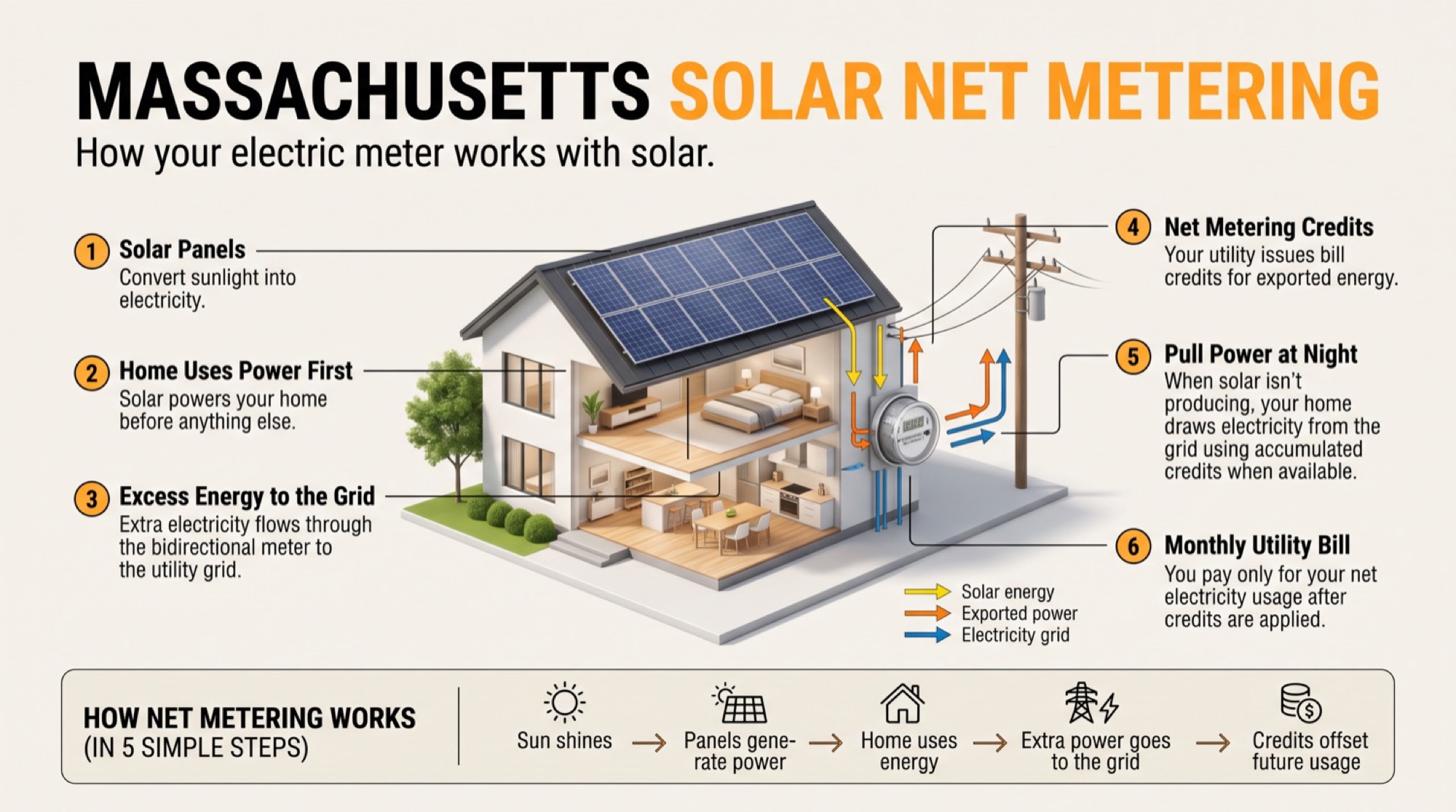
- Full-retail net metering — credits at the retail rate for excess power you export (residential systems under 60 kW).
- SMART 3.0 production incentive — a per-kWh production incentive on what your panels produce, for 20 years (residential ≤ 25 kW), on top of bill savings — the rate is calculated per project. Eversource, National Grid & Unitil territories only — not MLP towns.
- $1,000 state income-tax credit — the Massachusetts residential renewable-energy credit (MGL c.62 §6(d)).
- 6.25% sales-tax exemption — on qualifying solar equipment.
- 20-year property-tax exemption — on the added home value from your system.
- We file all of it — interconnection, net metering, and SMART enrollment handled by Nexis, start to finish.
How we handle the paperwork
Verify eligibility
We confirm your utility, SMART availability, and system-size rules for your address.
File interconnection
We submit and manage the utility interconnection application.
Enroll SMART
We enroll your system in SMART and set up net metering.
You collect
Credits and incentives flow — you just watch production in the app.
The full MA incentive stack
MA net metering, the 20-year SMART incentive, the $1,000 state credit, and tax exemptions all apply as of 2026. We compute your specific numbers and compare ownership vs. third-party options. (All figures verified per address at your assessment; SMART tariff details subject to DPU updates.)
For full program details, visit the official Massachusetts SMART 3.0 website.
See exactly what your address qualifies for
Book a free assessment — we'll verify your utility and SMART eligibility and calculate your net-metering + SMART value for your specific home.
Incentives FAQ
Answers, straight up
SMART 3.0 is a Massachusetts program that pays you for every kWh your panels produce (a technical, project-specific calculation), separate from and on top of your net-metering bill savings. Residential systems (≤ 25 kW) receive it for 20 years. It's available in Eversource, National Grid, and Unitil territories — not municipal-light-plant (MLP) towns.
Net metering credits you for excess power you send back to the grid, lowering your bill. SMART pays you a production incentive on everything your system generates. They stack — most MA homeowners get both, and Nexis files both.
Net metering, the 20-year SMART incentive, the $1,000 state credit, and sales/property-tax exemptions all apply as of 2026. We verify exactly what your address qualifies for and file every form.
If your utility is Eversource, National Grid, or Unitil, yes. Municipal-light-plant towns (e.g., Hingham, Taunton, Concord, Wellesley) aren't in SMART but often have their own local programs. We verify your address and show what applies.
We do — interconnection, net metering, and SMART enrollment are all handled by Nexis. You don't chase any forms.
Ready when you are
Book my free assessment
Same-week appointments across eastern MA. We bring the rebate math, you get a lower bill and a more comfortable home — $0 down to start.
